The Path to Hidden Knowledge, art exhibition curated by Nina Kokkinen, 3.6.– 11.10.2020 at Villa Gyllenberg, Helsinki.
In light of Villa Gyllenberg’s past history of presenting quite a traditional and conservative repertoire, the exhibition The Path to Hidden Knowledge in the summer and autumn of 2020 was out of the ordin ary and surprising: crystals hung from the ceiling, an illuminated rose window was laid out on the floor and newage music flowed by in the background. The museum’s architecture was modified to create oriental doorways and dark, mirrored rooms. Curated by Nina Kokkinen, an art his torian and postdoctoral researcher in the study of religion, the exhibition focused on how Finnish art between 1890 and 1950 was influenced by esoteric ideas originating from many sources, ranging from Rosicrucianism to Anthroposophy, Theosophy, and Freemasonry. The theme of the exhibition, as well as the artists and works included in it, can be explored in more depth in the book Spiritual Treasures: Esotericism in the Finnish Art World 1890– 1950 (eds. Nina Kokkinen and Lotta Nylund), published in connection with the exhibition. In the exhibition famous arthis torical works were interspersed with those from relatively unknown names, as well as items such as altars, candlesticks and skulls. This exhibition brought to light the fact that though researchers have been inter ested in esotericism in art for a long time, the Finnish art scene has not been very much explored through those lenses. This exhibition was therefore important in the way it deepened and broadened the wider audience’s view of twentiethcentury art. And it is indeed timely, particularly in view of the latest groundbreaking exhibitions around the world of the work of Hilma af Klint. Spirituality, selfunderstanding and higher knowledge are actually also the leit motifs for the museum, a path laid out by its founder Ane Gyllenberg, the banker and art collector whose worldview was intim ately bound up with Anthroposophy and Freemasonry.

The exhibition offered glimpses of established artists such as Akseli Gallen Kallela, Hugo Simberg, Ellen Thesleff and Helene Schjerfbeck, who were all inter ested in esotericism in one way or another. Many of them were never actual members of any movement, but rather seekers after truth who combined in their works spirit ual impressions from a variety of sources. However, the exhibition also included works by relatively unknown artists, such as Ilona Harima, Meri Genetz and Werner von Hausen. Harima was familiar with the Theosophical worldview and in a work she produced in the 1930s, The Distant Mes sage (Kaukainen viesti / Fjärran budskap), she puts forward the idea of progressive reincarnation. This small painting depicts an Oriental god figure holding a planet in his hand. Birds are flying towards it, like golden souls. To the left of the god figure, thesoulshavetransformedintoeyes.This transformation refers to the knowledge, skills and higher wisdom that the souls have attained during their bodily lives on the planet. Torsten Wasastjerna’s large trip tych When Nature Sleeps, the Spirit Watches (Kun luonto nukkuu, henki valvoo / När naturen sover, vakar anden, 1898) had not been displayed in its entirety for 120 years, and one can only wonder why. The symbol ist landscape in the centre is surrounded by two angels at the sides – one with its sword pointing up, the other down. The angel paintings were found during the cur ation process in the temple of the Finnish Rosicrucian Society (RuusuRisti ry), founded by the Theosophist Pekka Ervast.
Gazed at by portraits
Instead of focusing on art history, the cur ator of this exhibition had a more play ful intention involving initiatory experi ence, and the presentation worked as a kind of ‘handbook for spiritual seekers’. For example, black footprints on the floor directed visitors through the exhibition, and the idea of the seeker was heightened by Hugo Simberg’s small but powerful The Stream of Life (1896). A great variety of styles were in evidence. The exhibition explored the theme of initiation in detail and sought different approaches to it. For example, GallenKallela claimed in his writ ings that art has its origins in the human need to find a form for the divine mysteries of life and death. As a whole the exhibition made me see how the function of art itself can also be thought of as an initiation: art is meant to give its creator or viewer access to the kind of knowledge, emotions and experiences which they would not other wise have been able to find. In this way, ideas about initiation are intertwined with artistic work and how it is received.
The question ‘Who am I?’ set its imprint on the entire first room: it was full of por traits and large mirrors that made the visitor feel they were being observed from all sides. Emil Halonen’s nearly twometre tall aspen wood Christ figure formed a kind of centrepiece. Emil Halonen was a member of the Finnish Rosicrucian Society and this sculpture was borrowed from the society. It is usually installed as a center piece in their temple. In an intriguing por trait by the Anthroposophist Eva Törnwall Collin, a cigarettesmoking Rabbe Enckell regards himself in a mirror where he has a devil’s face. There were also three highly passionate portraits by Meri Genetz, who was very interested in, for example, Theosophy, Kabbalah and Spiritualism. The broad selection of portraits – and especiallyselfportraits – showed that Finnish artists were influenced by the tendency to ponder on the deep mysteries of life which was very common in Paris in the early 1890s. Questions like ‘What am I and where have I come from; where am I going and what am I going to do?’ were all intrinsically linked to esotericism. Beda Stjernschantz’s Aphorism (1895) is also clearly related to reflections on human existence, portray ing a young boy dressed in a black robe typical of initiated masters and truthseek ers. At the bottom one can read Descartes’s cogito, ergo sum (‘I think, therefore I am’). The boy’s eye cannot be caught since he is focusing on his own inner world. In addi tion to this his hands are gesturing the figure eight, suggesting eternity. Their posi tion also closely resembles the Dharma chakra mudra oriental hand gesture, which is common not only in representations of the Buddha but also of many other masters from India and Tibet. In findesiècle occul ture, the Buddha was regarded as one of the most important masters of hidden knowl edge. Stjernschantz’s painting suggests that the same knowledge can be reached through introspection and exploration of the inner world of the self.
Death in focus
The memento mori and the symbolist figure of death were key themes in the black toned middle room of Villa Gyllenberg, where muted church bells dramatically played softly in the background. Symbolic death often represents one stage in esoteric initiation and the path it offers to spiritual development. This room was filled with a mixture of paintings depicting memento mori themes such as skulls, watches and hourglasses, and candles. The back wall was totally taken up by Oscar Parviainen’s large painting, the Crypt of the Capuchin Friars (Kapusiinimunkkien hautakammios sa, 1914), stocked full of skulls. Next to it stood a table arrangement with a masonic candlestick, an hourglass and a skull from Akseli GallenKallela’s collection; there was also a painting of his, River of the Dead (Kuolleitten virta / De dödas flod, 1893), and pictures of a peasant and Death by Hugo Simberg. There were rather shock ing revelations for me, such as how Gallen Kallela would be so extreme in his creative process that he occasionally would lie down in a newlydug grave after his afternoon coffee, when he was doing frescos for the Jusélius Mausoleum at a cemetery in Pori! He claimed he drew creative power from the earth of the dead and was able to feel the force and energy of the world soul. He also wore a monk’s habit, and in 1897 his student Hugo Simberg had, in Italy, con templated living as a monk devoted to art. In a throwback to romanticism, both artists perceived nature as endowed with soul and full of life.
Rose window under your feet
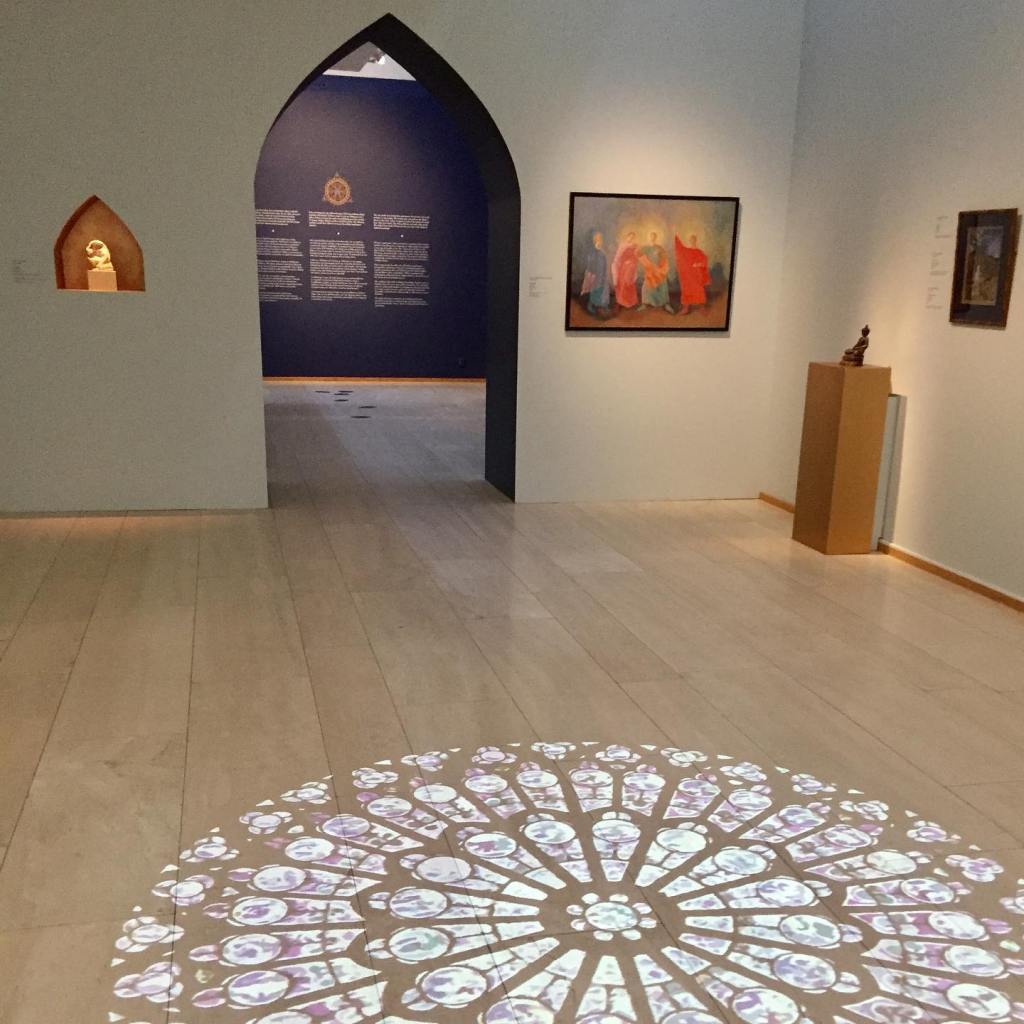
The last room in the exhibition was bright and filled with soft, abstract sounds, likeglitter. The mise en scène seems like a path to redemption, and the question that came to me was ‘Who are we?’, in the sense that we all come from the same light. On the floor, like a carpet, was a glowing rose win dow and the entrance to the space was oriental in shape. An eighteenthcentury statue of the Buddha was accompanied by a Rosicrucian candlestick and Eva Törnwall Collin’s picture of eurythmy. Next to it was Ellen Thesleff’s abstract Angel with Trombone (Pasuunaenkeli / Basunängeln, 1925) and Sakari Tohka’s bronze angel (1939). Thesleff’s delicate, ethereal style differs markedly from Tohka’s masculine idiom. Overall, the room featured many pictures of angels, which appear as guides to spiritual wisdom. Akseli GallenKallela’s large Ad Astra (1907) functioned as a kind of terminus, altar, or focus point. In the painting the red hair of the maiden, ascend ing into the celestial spheres, shimmers magnetically, and her eyes evoke a state of clairvoyance. Behind the maiden shines a golden planet: her future. The maiden’s pose suggests not only the Christian resurrection, but also the crucifixion which is underlined by the stigmata. Therefore, the Christian theme of the resurrection inter twines with the idea of progressive rein carnation, which became common during the nineteenth century with the spread of Theosophical ideas, for example. This famous painting is usually part of the Gyllenberg Collection and it appeared very differently in this setting, more clearly denoting the rebirth of the soul.
The sphinx and the hexagram
What, then, are the criteria for a work to be identified as belonging to esoterica? The whole question can appear rather woolly, considering that this was the period of Symbolism and that much of Modernism demonstrates a kind of quest for truth. One entire wall in the exhibition was dedicated to Helene Schjerfbeck’s paintings – rather surprising, one might think, and yet prom inent spiritual features are identifiable in a painting of a female profile surrounded by scratched gold, like a halo, showing how Schjerfbeck delved into the spiritual on a highly individual plane. In general, spirit ualist teachings and secret séances offered women artists the opportunity to experi ment more freely than was otherwise cul turally acceptable at the time. I would have liked to see more of such experimental works in the exhibition, such as examples of automatic drawing.
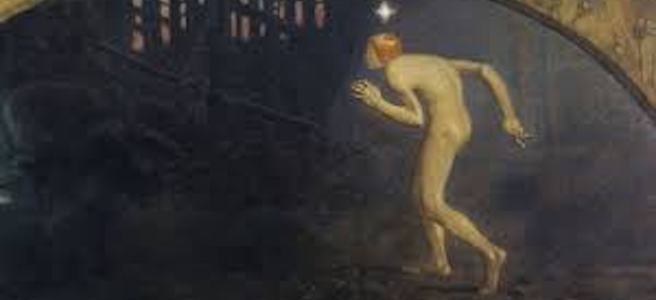
By contrast to Schjerfbeck’s Expression ism, masonic symbols are quite clear, and Anthroposophical imagery has a distinc tive framework in its hazy and pastel expression. Recurring symbols in the exhibition included the hexagram and the sphinx, as well as seekers and wanderers in search of the light, such as Onni Muu sari’s The Treasure Hunter (Aarteenetsijä / Skattsökaren, 1910). In this large painting, a naked young man cautiously approaches a glowing light in the dark forest. It is all set in a fairytalelike atmosphere. Artists in general during this time were consid ered to have a special talent for clairvoy ance and were frequently called prophets or magicians. Artists often depicted them selves as pilgrims, clad in a robe and with a wanderer’s staff in their hand. Muusari’s truthseeker is depicted naked, without a robe or cloak, more like a mythical sphinx. The nakedness of the seeker underlines his authenticity, sincerity and the purity of his intentions. The painting shows that this truthseeker has, after a long journey, finally found his treasure, the source of light and higher wisdom. The same source of enlightenment also shines above the young man’s head.
The longing for an answer
Should, then, the artists in the exhibition be seen as artists or as mediums? Some of the featured artworks seem like maps of a spir itual endeavour, but also like expressions of a tumultuous period that felt a need for this kind of spirituality. As a whole, the exhibition neither prophesied nor lectured. It functioned as a mixture of elements associ ated with esoteric spirituality, and it offered a view into, and a new interpretation of, the history of art, but also raised intrigu ing questions about why the theme is still of interest at this specific point in time. In an age of rational thinking, industrialisa tion and urbanisation, artists embarked on a quest for a deeper truth – issues that are topical even today. I can assume that some GallenKallela enthusiasts may be offended by the discovery of this esoteric side of our national artist. Esotericism has been given a negative label because it has been associ ated, for example, with Nazis, hippies, and drugtaking. In this respect, the exhibition functioned as a platform for discussion. It raised questions about how we see life today and how the history of art is written. It left me with the notion that if we have the understanding and the sense to appre ciate human beings striving for the beauty embodied in art, then can we not also appreciate human questions and the need for answers? I hope to see more exhibitions of this kind in Villa Gyllenberg. It would also be rewarding to explore the esoteric in abstract and contemporary Finnish art, even if little research has been done in this area.
Camilla Granbacka
Camilla Granbacka is an art historian specialising in contemporary art and modernism. She is currently working as a curator at the Pro Artibus Foundation. She has worked as an art critic for Hufvudstadsbladet and also for Dagens Nyheter and konsten.net.
Reference: Kokkinen, Nina, 2020. ‘Initiation in art and esotericism’, in Spiritual Treasures: Esotericism in the Finnish Art World 1890–1950, eds. Nina Kokkinen and Lotta Nylund (Hel sinki: Parvs), 8–23.
Published in the journal Approaching Religion Vol. 11/1 (2021).You find the journal open access at https://journal.fi/ar/
Theme: “Seekers of the spiritual art and higher wisdom: Encounters between art and esotericism”. Guest editor: Dr. Nina Kokkinen, University of Turku. This issue is based on a two-day seminar arranged in Helsinki in August 2020 by the Signe and Ane Gyllenberg Foundation under the title ‘Clear-sighted Art – Open Mind? Encounters between Art and Esotericism’. The seminar was arranged as a pendant to the art exhibition The Path to Hidden Knowledge that was open in the foundation’s museum, Villa Gyllenberg, from June to October. The organising committee included Siiri Oinonen and Lotta Nylund from the Gyllenberg Foundation, Nina Kokkinen, University of Turku and Ruth Illman, the Donner Institute.
AR is an open access journal published by the Donner Institute. Its purpose is to publish current research on religion and culture and to offer a platform for scholarly co-operation and debate within these fields. The articles have been selected on the basis of peer-review.

 konstkontentan